


By noon, your feet already feel like they've done a double shift. Wet, hot, rubbing against the boot seam, smelling like you walked through a locker room. That's not a you problem. That's a sock problem.
Bamboo mens work socks have been getting serious attention from tradesmen, warehouse workers, and anyone who spends eight-plus hours on their feet. The question isn't whether they sound good on paper. The question is whether they actually hold up once the boots go on.
Key points at a glance
- Bamboo fabric pulls moisture away from skin and resists odor better than cotton or standard synthetics.
- Crew cut bamboo socks are the most practical length for work boots, staying in place all day.
- Look for reinforced heel and toe zones: bamboo alone won't survive rough boot interiors without them.
- Bamboo socks suit diabetics and men with sensitive feet because the fiber is naturally soft and non-irritating.
- Washing cold and air-drying adds months to the lifespan of any bamboo sock.
- Budget picks exist, but the $12, $18 per pair range is where durability and comfort actually meet.
Why Bamboo Works for the Working Man
Why Your Current Work Socks Are Failing You by Noon
Cotton absorbs sweat. That sounds like a good thing until you realize it holds that moisture against your skin for the rest of the shift. Wet feet inside a closed boot mean blisters, hot spots, and by the end of the day, a smell that clears a room.
Standard polyester blends wick better but create their own problem: they don't breathe, they trap heat, and the cheap ones pill and bunch inside the boot within a few weeks.
Neither option was designed for a ten-hour day on concrete. That's the gap bamboo work socks are filling.
What Bamboo Actually Does Inside a Work Boot (The Short Version)
Bamboo viscose fiber has a micro-porous structure. Sweat moves through the fiber and evaporates instead of sitting against your skin. That's not marketing language, that's basic textile science.
It also resists bacterial growth without any added chemical treatment. Fewer bacteria means less odor. After a full day in steel-toes, that matters more than most guys admit.
Did you know?
The average person's feet produce around 250 ml of sweat per day. Inside a sealed work boot, that moisture has nowhere to go unless your sock is actively moving it away from the skin. Bamboo viscose absorbs and releases moisture roughly three times faster than cotton.
Are Bamboo Socks Good for Work? Honest Answer Here
Yes, with one condition: the construction has to match the job. Pure bamboo is soft but not indestructible. If the sock doesn't have a reinforced heel, a reinforced toe, and a good nylon or spandex blend to hold shape, it won't survive a rough boot interior for more than a couple of months.
The best bamboo work socks pair bamboo viscose (usually 60, 75%) with nylon for durability and a small percentage of spandex for fit. That combination gives you all the comfort benefits of bamboo without sacrificing longevity.
Read also: Best mens workwear approved by experts for 2026
What to Look for in Bamboo Mens Work Socks Before You Buy
- Bamboo content 60% or higher: below that and you lose most of the moisture-wicking benefit
- Reinforced heel and toe: non-negotiable for work boot wear
- Cushioned sole: look for a terry loop cushion underfoot, especially if you're on concrete
- Arch compression band: keeps the sock from sliding into your boot mid-shift
- Seamless or flat-knit toe: reduces friction points that cause blisters
- Crew cut length: long enough to protect the ankle against boot collar rub
Best Bamboo Mens Work Socks Worth Your Money in 2026
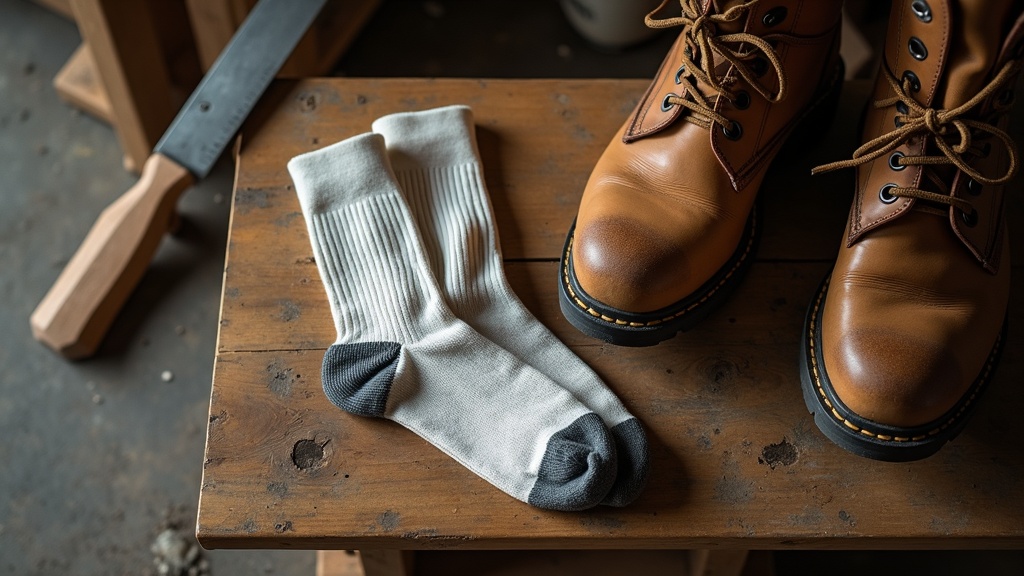
The market has grown fast. Here's how the main options stack up across the criteria that actually matter on the job.
| Sock Type / Brand Profile | Bamboo % | Best For | Price Range |
|---|---|---|---|
| Heavy-duty bamboo crew (thick cushion) | 63, 70% | Concrete, warehouse, construction | $14, $18/pair |
| Mid-weight bamboo work crew | 70, 75% | All-day standing, mixed environments | $11, $15/pair |
| Bamboo diabetic-friendly work sock | 75, 80% | Sensitive feet, circulation issues | $13, $17/pair |
| Budget bamboo blend (low nylon) | 50, 58% | Light duty, office/field hybrid | $6, $10/pair |
| Premium bamboo merino blend | 50% bamboo / 30% merino | Cold jobsites, outdoor trades | $18, $26/pair |
The sweet spot for most tradesmen is the mid-weight or heavy-duty crew at $12, $18 per pair. Anything below $8 per pair tends to skimp on bamboo content or skip reinforcement.
Crew vs. Other Cuts: Which Style Works Best on the Job
Crew bamboo socks for men are the standard for a reason. The crew height, typically 6, 8 inches up the leg, sits above the boot collar and prevents the ankle abrasion that quarter-cut socks allow.
Quick cut comparison
- Crew (6, 8"): best all-around for work boots, protects the ankle, stays up
- Quarter (3, 4"): fine for low-profile sneakers, not ideal for work boots
- Mid-calf (10, 12"): good for taller boots, adds warmth in winter
- No-show: avoid entirely in work boots, they bunch and cause blisters fast
Did you know?
Bamboo plants can grow up to 91 cm (about 3 feet) in a single day under the right conditions. That makes bamboo one of the fastest-renewable textile sources available, which is part of why bamboo socks have a significantly lower water footprint than cotton equivalents.
Are Bamboo Socks Good for Diabetics or Guys with Foot Problems?
Yes, and this is one area where bamboo genuinely stands out. Bamboo socks for diabetics work well because the fiber is naturally soft, non-abrasive, and free of the rough seams that create pressure points. For men managing neuropathy or reduced circulation, that matters every single day.
Look for versions specifically labeled diabetic-friendly. They'll typically feature a non-binding top band (no tight elastic cuff cutting off circulation), a seamless toe, and extra cushioning under the ball of the foot.
How to Make Work Socks Last Longer (Stop Trashing Them Early)
Most guys ruin their socks in the laundry, not on the job. A few simple habits add months to the lifespan of any bamboo work sock.
- Wash cold, always. Hot water breaks down bamboo viscose faster than anything else.
- Skip the dryer when you can. Air-dry flat or on a rack. The dryer is fine occasionally but heat degrades elastic and bamboo fiber over time.
- Turn socks inside out before washing. Protects the outer surface and cleans the sweat-side more effectively.
- No fabric softener. It coats the bamboo fibers and kills moisture-wicking performance.
- Rotate at least five pairs. Wearing the same pair daily, even with washing, shortens the life significantly.
Read also: Best Carpenter Work Boots Tested by Professionals for Jobsite Safety
The Bottom Line: Are Bamboo Work Socks Worth It?
If your current socks leave your feet wet, stinking, or blistered by midday, switching to a quality pair of bamboo mens work socks is one of the cheapest upgrades you can make to your workday. We're talking $15, not $150.
They won't turn a bad pair of boots into a good one. But a reinforced-heel, high-bamboo-content crew sock will keep your feet drier, cooler, and more comfortable than anything cotton you've been pulling on for years.
Pick a mid-weight crew, verify the bamboo content is above 60%, check for cushioning and reinforcement, and wash them cold. That's the whole playbook. Your feet will figure out the rest by lunchtime.
