


Your heel hurts. Not in a "I've been on my feet for 12 hours" way. In a sharp, stabbing, why does it hurt more in the morning kind of way. If that's familiar, there's a good chance your work boots are part of the problem — and maybe not in the way you'd expect.
What Is Achilles Tendonitis, Exactly?

The Achilles tendon connects your calf muscles to your heel bone. It handles an enormous amount of load — every step, every shift, every time you climb a ladder or crouch behind a machine. Achilles tendonitis is what happens when that tendon gets overloaded, inflamed, and starts to break down faster than it can recover. The pain usually shows up right above the heel, sometimes in the morning before it loosens up, sometimes during or after long days on your feet.
Left alone, it gets worse. Much worse. We're talking potential tendon rupture territory. Here's the part people miss: the boots you wear eight to twelve hours a day have a massive influence on whether that tendon stays healthy — or gets ground down over time.
Can Work Boots Actually Cause Achilles Tendonitis?
Yes. Not always directly, but the mechanics are well-documented. Here's how it happens.
1. A heel drop that's too low (or zero)
Most modern work boots — especially "lightweight" or athletic-style options — have a very flat sole. That sounds comfortable, but for your Achilles tendon, flat means stretched. All day. Every day.
The Achilles needs a slight heel elevation (usually around 10–15mm) to sit in a relaxed, neutral position. When that support disappears, the tendon is under constant low-grade tension, and chronic tension leads to chronic inflammation.
This is probably the most common boot-related cause of Achilles tendon pain in workers. And it's one almost nobody talks about when buying boots.
2. A heel collar that's too stiff or sits in the wrong spot
The back of a work boot — the part that wraps around your heel — is called the heel collar. If it's too rigid, or positioned slightly too high, it can press directly on the Achilles with every step. That kind of repeated mechanical stress causes localized irritation that gets harder and harder to ignore.
Some people describe it as a burning sensation at the back of the ankle. Others notice the skin gets raw first, then the pain goes deeper.
3. No Achilles protection or cushioning at the heel

A surprising number of work boots offer almost no cushioning at the heel itself. Hard insoles, thin midsoles, and rigid outsoles transfer every impact from concrete, asphalt, or steel grating directly up into the heel and Achilles. Over a long shift, that adds up to thousands of small shocks with nowhere to go.
4. Poor arch support
This one's indirect, but real. When the foot's arch collapses inward (overpronation), the whole leg mechanics shift — and the Achilles tendon absorbs the extra rotational stress. A boot with flat, unsupported insoles quietly sets this chain reaction in motion.
Check out this detailed guide: What to Wear for Warehouse Work: Complete Guide for Safety & Comfort
The Warning Signs to Watch For
Early Achilles tendon issues are recoverable. Ignored ones turn into chronic tendinopathy that can sideline you for months. Pay attention if you notice:
- Stiffness in the back of the heel, especially the first few steps in the morning
- Pain that kicks in during or after a long shift — not before
- A tender spot roughly 2–6 cm above the heel bone
- Any swelling or thickness along the back of the ankle
- A crunching or creaking sensation when you flex your foot
The morning stiffness thing is a tell. If your heel loosens up after walking for 10–15 minutes, that's the classic Achilles pattern. If any of this sounds like what you're dealing with right now, the next section is the one worth reading carefully.
What to Look for in Work Boots That Don't Destroy Your Achilles
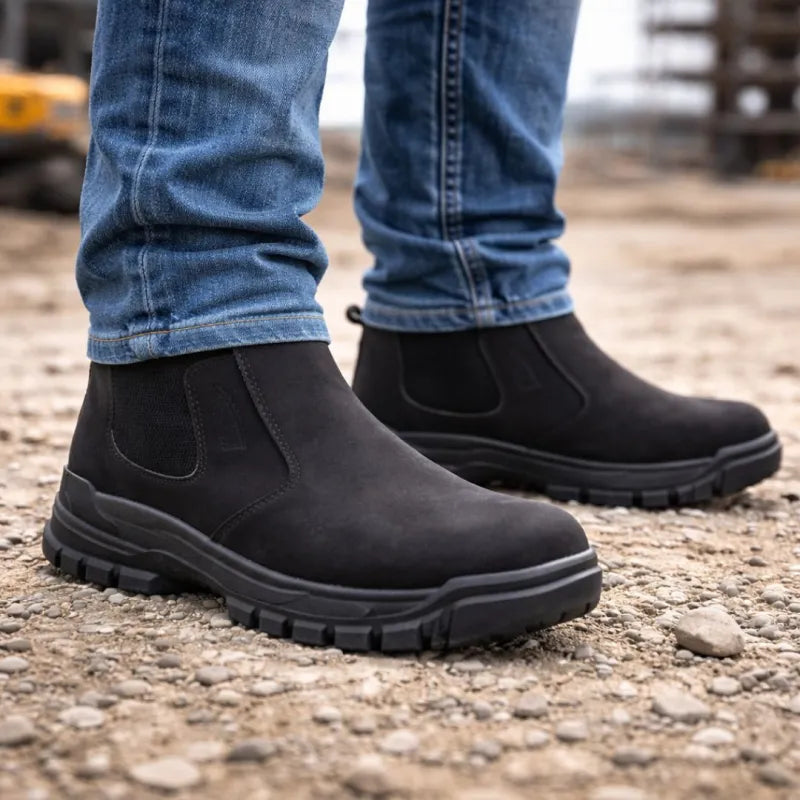
Not every work boot causes Achilles problems. The ones that protect you share a few key traits.
- Heel elevation between 10–15mm. Not wedge soles, not zero-drop — a moderate heel raise that keeps the tendon in a neutral position through long shifts.
- A padded heel collar. Soft, cushioned material at the back of the boot prevents direct pressure on the tendon insertion. This is non-negotiable if you've had Achilles issues before.
- Genuine arch support. Not just a foam insole, but real structural support under the midfoot. This keeps the foot from rolling inward and transmitting stress up the chain.
- Shock-absorbing midsole. Something that actually absorbs impact rather than sending it straight into the heel. Dual-density EVA or PU compounds are common in quality boots.
- A heel counter that holds without biting. The heel cup should stabilize the foot without pressing into the Achilles. If you can feel the boot "digging in" at the back, that's a problem boot.
Mason's Best Work Boots — Built With This in Mind
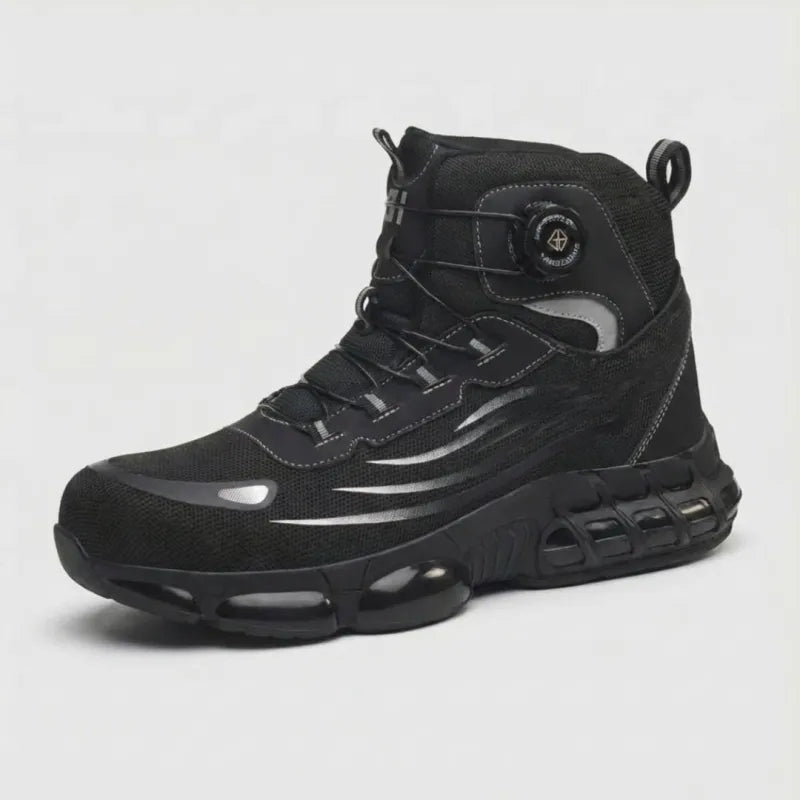
At Mason, we've built our best work boots specifically for people who spend full days on their feet in demanding environments. Here are the three models worth knowing:
1. ATLAS S3 Pro | Safety Boots
The Atlas S3 Pro is our flagship daily-use boot. It combines steel toe protection with a well-designed heel collar and a midsole built for long shifts on hard surfaces. The heel construction sits at an angle that reduces Achilles strain — a detail that makes a real difference when you're clocking 10-hour days. The outsole offers solid grip across wet, oily, or uneven surfaces.
If you're on your feet on a construction site or in a warehouse and you want a boot that takes your tendon health seriously, this is the one to start with.
2. STRIDE S1 Pro | Slip-On Steel Toe Boots
Sometimes you don't want laces. The Stride S1 Pro is a slip-on with a steel toe and a silhouette that keeps the heel collar soft and well-positioned.
For people who've had Achilles flare-ups triggered by rigid boot backs, the Stride's more flexible upper can be a meaningful change. It's also one of the better-value boots we carry — the current price is hard to argue with.
See the Stride S1 Pro
3. POLAR S3 Pro | Winter Safety Boots
If you work outside in cold months, the Polar S3 Pro handles low temperatures without the usual trade-off of stiffness. A cold, inflexible boot can seriously aggravate Achilles issues — the tendon itself gets less pliable in the cold, and a boot that fights your foot's natural movement makes that worse.
The Polar keeps warmth without sacrificing the cushioning and fit that keep your heel healthy through winter shifts.
See the Polar S3 Pro
Don't Forget the Insole
Even the best boot has a stock insole that's designed to fit most feet — not your feet. If you're dealing with Achilles pain, adding a proper aftermarket insole with heel cushioning and arch support is often the single most impactful change you can make.
Mason also carries insoles made specifically for work boots — worth pairing with any of the models above.

When Boots Aren't Enough
If you've already been dealing with Achilles tendon pain for more than a few weeks, better boots will help — but they won't fix the underlying inflammation on their own. See a physiotherapist. The eccentric calf raise protocol (look it up) has strong evidence behind it for Achilles recovery. Ice, load management, and rest matter too. Boots reduce stress on the tendon. They don't undo damage that's already there.
Check out this detailed guide: Best Pull-On Work Boots for Plantar Fasciitis Relief
Can Work Boots Cause Achilles Tendonitis: Final answer
Can work boots cause Achilles tendonitis? Yes — through poor heel drop, stiff or misplaced heel collars, lack of cushioning, and bad arch support. The good news is that the right boots genuinely help, and switching to a boot designed with heel and tendon mechanics in mind can stop the problem before it gets serious.
If your current boots are flat, stiff at the back, or just battered past the point of providing real support — your Achilles is paying for it, slowly.
