


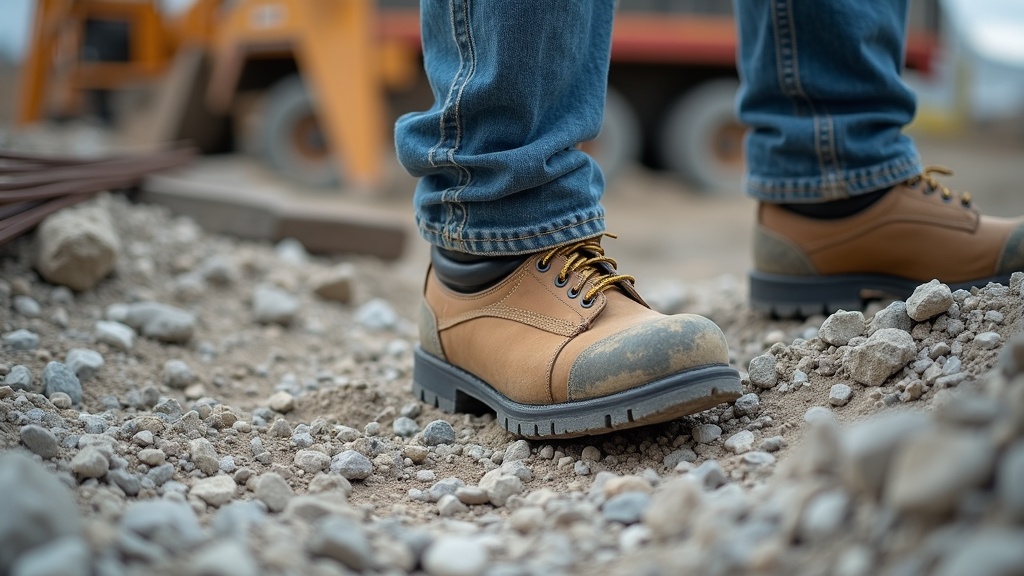
That feeling when your ankle rolls on a chunk of broken concrete and your whole leg just gives out for a second? That's not normal wear and tear. That's ankle instability from uneven jobsite terrain, and it gets worse every single time you ignore it.
The job doesn't slow down. You can't just sit on the tailgate and ice it for a week. But here's the thing: there are real fixes, and most of them don't require a doctor's office or time off the clock.
Key points at a glance
- Uneven ground is the leading trigger for chronic ankle instability in trades workers
- Your ankle giving out without a fresh injury is a red flag, not just bad luck
- Specific exercises done before and after a shift can rebuild ligament control fast
- The right brace and boot combo cuts re-injury risk significantly on rough ground
- Ignoring it leads to arthritis, torn ligaments, and eventually surgery
- Healing is possible even without taking time off, if you act smart now
What this guide gives you
Why Jobsite Terrain Tears Up Your Ankles (And Why It Gets Worse Over Time)
Gravel, rebar cuts, muddy slopes, uneven concrete pads, pallets with broken boards. Every step on that kind of ground forces your ankle to make dozens of micro-corrections. Your ligaments handle that load, not your muscles.
The first time you roll it, the ligament stretches. It doesn't fully snap back to its original tension. You walk it off. A month later it rolls again, a little easier than before. That's how chronic ankle instability builds: not one big injury, but a slow accumulation of small ones your body never fully fixed.

The ankle joint relies on three main ligaments on the outside (lateral) side. Once those are repeatedly overstretched, your brain actually loses accurate signal from them. That's called proprioceptive deficit, and it's why your ankle gives out on uneven ground even when you're being careful.
What Ankle Instability Actually Feels Like on the Job
It's not always dramatic. Most guys describe it as the ankle just "giving" for a split second, then catching itself. You might feel a brief wobble stepping off a curb or crossing a gravel lot.
- Frequent rolling or near-rolls on surfaces that didn't used to bother you
- A vague ache on the outside of the ankle after a long shift
- Sudden ankle weakness without any new injury or obvious cause
- Stiffness in the morning that loosens up but never fully goes away
- Feeling like you have to watch every step on uneven ground
That last one matters. When you're mentally compensating for an ankle you don't trust, you're distracted. On a jobsite, distraction has consequences that go beyond the ankle itself.
Did you know?
Research published in the Journal of Athletic Training found that up to 40% of people who sprain an ankle once will develop chronic ankle instability if they don't complete a structured rehab program. Most workers never do any rehab at all.
Two Danger Signs Your Ankle Ligaments Are in Real Trouble
Most ankle instability can be managed without surgery. But two signs tell you it's time to stop guessing and get imaging done.
Sign 1: Swelling that comes back every week
If your ankle swells up after every shift, even a moderate one, you may have a ligament that's fully torn rather than just stretched. Chronic swelling means chronic inflammation, which means tissue damage that isn't healing on its own.
Sign 2: Mechanical locking or catching
A feeling that something is physically blocking your ankle's movement, or a clicking sensation during normal walking, can signal cartilage damage or a loose body in the joint. That's a different problem than ligament laxity and it does not respond to exercises or bracing.

Can Ankle Instability Be Fixed, or Are You Just Living With It?
It can be fixed. Chronic ankle instability responds very well to a combination of neuromuscular retraining and external support, when you're consistent about it.
The ligaments themselves won't regrow to their original tension. But the muscles around the ankle, particularly the peroneals on the outside of the lower leg, can be trained to pick up the slack. That's the whole game with how to fix chronic ankle instability without going under the knife.
Surgery (the Brostrom procedure) is reserved for cases where conservative treatment has fully failed, usually after six months. Most people never get there if they act early.
The Best Ankle Instability Exercises You Can Do Before and After a Shift
These don't require a gym. A flat piece of ground and ten minutes is enough.
Before your shift: activation
- Banded eversion: Loop a resistance band around your foot, anchor it, and push outward 15 times. This fires the peroneals before they're needed.
- Heel raises: Slow controlled raises on both feet, then single leg. 3 sets of 12. Takes four minutes.
- Ankle circles: 10 full rotations each direction. Warms up the joint fluid and primes proprioception.
After your shift: rebuild
- Single-leg balance: Stand on the bad ankle for 30 seconds. Eyes open first, then closed. The eyes-closed version is where the real retraining happens.
- Step-down control: Stand on a low step, lower yourself slowly on one leg. This trains the deceleration pattern that fails when your ankle gives out on uneven ground.
- Calf stretches on a slant: Tight calves pull on the Achilles and shift load to the lateral ligaments. Stretch them daily.
Did you know?
Single-leg balance training with eyes closed improves ankle joint position sense by activating Golgi tendon organs in the ligaments themselves. A 2020 study in Physical Therapy in Sport showed measurable proprioceptive improvement in just 4 weeks of daily balance training in workers with chronic ankle instability.
Braces, Boots, and Gear: What Actually Holds Your Ankle Steady on Rough Ground
There are two layers of external support worth understanding: the brace and the boot. They do different things and work best together.
The best brace for ankle instability on a jobsite
A lace-up stirrup brace like the ASO (Ankle Stabilizing Orthosis) or the Zamst A2-DX gives you rigid lateral support without locking out plantarflexion. That means you can still walk normally while the brace handles the roll. Sleeve braces with no rigid straps are nearly useless on uneven terrain.
Work boots for ankle support
An 8-inch boot with a shank (the stiff plate between the insole and outsole) and a wide, stable heel base is your foundation. Look for a boot that laces tight around the ankle collar specifically, not just the foot. A loose collar on a high boot gives you false confidence.
| Support Option | Best For | Limitation | Cost Range |
|---|---|---|---|
| Lace-up stirrup brace (ASO, Zamst) | Daily prevention, moderate instability | Wears out faster in wet/muddy conditions | $30, $70 |
| Rigid air stirrup brace (Aircast) | Post-sprain recovery, severe instability | Bulky, fits fewer boot styles | $50, $90 |
| 8-inch lace-up work boot with shank | All-day terrain coverage, combined support | Doesn't replace a brace for true instability | $120, $250 |
| Custom orthotic insole | Corrects foot alignment that loads lateral ligaments | Requires fitting, higher upfront cost | $150, $400 |
| Compression sleeve only | Swelling control, mild soreness | Zero lateral stability on rough ground | $10, $30 |

How Long Does Ankle Instability Take to Heal When You Can't Take Time Off?
Realistic answer: four to eight weeks of consistent exercise gets most workers to a point where the ankle stops giving out. Full proprioceptive recovery takes closer to three months.
The catch is consistency. Doing the exercises three times in the first week and then stopping when the ankle feels better is exactly how people end up back at square one six weeks later.
If you're wearing a brace every shift, doing the exercises daily, and sleeping on it, you'll see real improvement inside a month. The ankle won't feel perfect, but it will stop being a liability on uneven ground.
What Happens If You Ignore It: The Real Cost of Letting It Go
This isn't scare talk. These are the actual downstream consequences, documented in orthopedic literature and workers' comp case files.
- Osteochondral lesions: Repeated rolling damages the cartilage on the talus bone. Once that cartilage is gone, it doesn't come back. This is how ankle arthritis starts in guys in their 40s.
- Peroneal tendon tears: The tendons that run along the outside of your ankle absorb extra load when the ligaments are loose. They eventually fray and tear.
- Compensation injuries: Your knee, hip, and lower back start overworking to protect the bad ankle. Knee problems in workers with chronic ankle instability are well-documented.
- Surgery and time off: The Brostrom reconstruction requires six to nine months of recovery. That's time you can't bill.
The guy who walks off a rolled ankle and tapes it up for two weeks loses nothing. The guy who walks off a rolled ankle for two years loses a lot more than an ankle.
Take action this week, not someday
Pick up a lace-up brace before your next shift. Start the single-leg balance drill tonight. Ten minutes a day and $50 in gear is the cheapest insurance policy on the jobsite. Your ankle's been warning you. Now you know what the warning actually means.
