


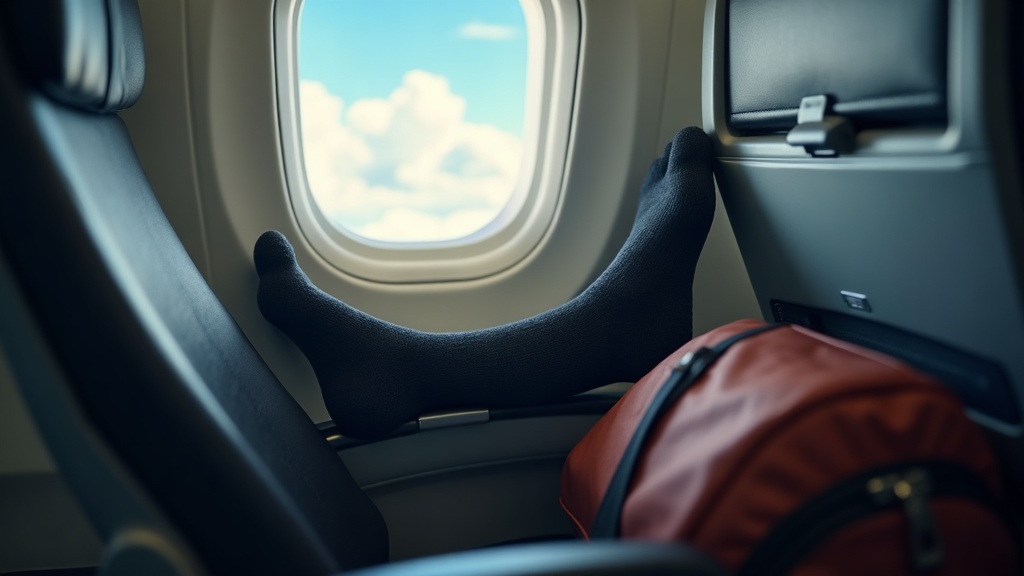
You land after eight hours in a middle seat, stand up, and your ankles look like they belong to someone twice your age. That's not a coincidence. That's what happens when you sit still at altitude with cabin pressure working against you, and no one told you to do anything about it.
The right compression socks fix this. The wrong ones just cost you money and leave red marks on your shins. Here's how to tell the difference.
Key points at a glance
- 15-20 mmHg works for most domestic flights; go 20-30 mmHg for long-haul international travel.
- Put your compression socks on before you leave the house, not at the gate.
- Wide-calf flyers need socks sized to their calf measurement, not just shoe size.
- Graduated compression (tighter at the ankle, looser up top) is the only design worth buying.
- Avoid cotton-heavy blends: they hold moisture and lose elasticity fast.
- DVT risk goes up after 4 hours of sitting, which is exactly why long-haul flights are the priority.
What good compression socks do for you in the air
Why Your Legs Take a Beating at 35,000 Feet (And Why It Matters for Working Men and Women)
Cabin pressure in a commercial aircraft is set to the equivalent of sitting at 6,000 to 8,000 feet of elevation. That lower pressure causes blood vessels to expand slightly, which slows circulation in your legs, especially when you're bent at the knee for hours with nowhere to go.
Add in dehydration from recycled air, and you've got a setup for swelling, aching legs, and in serious cases, deep vein thrombosis (DVT). This isn't a problem reserved for elderly passengers. Construction workers, tradespeople, and anyone who spends their days on their feet and then sits frozen in a coach seat is at risk.
Read also: Best Compression Socks for Women Travel: What Actually Works
What Level of Compression Do You Actually Need for Flying (mmHg Explained Without the BS)
mmHg stands for millimeters of mercury. It's the pressure unit used to measure how hard the sock squeezes your leg. Higher number means more squeeze.
Here's a plain-English breakdown:
- 8-15 mmHg: Light support. Fine for a 90-minute hop. Won't do much on a 9-hour transatlantic.
- 15-20 mmHg: Moderate compression. Good for flights up to 5-6 hours. The right call for most domestic travel.
- 20-30 mmHg: Firm compression. What you want for long-haul international flights. This is the standard for compression socks flying international routes.
- 30-40 mmHg: Medical-grade. Requires a doctor's recommendation. Not necessary for travel unless you have a specific condition.
Did you know?
A study published in the Cochrane Database of Systematic Reviews found that travelers wearing compression stockings on flights over 4 hours had significantly lower rates of symptomless DVT compared to those who wore none. That's not marketing copy. That's clinical data.
Is 20-30 mmHg Too Much for a Flight? Here's the Straight Answer
No. For healthy adults on long-haul flights, 20-30 mmHg compression socks for travel are the sweet spot. They're firm, but not painful when sized correctly. If they feel like a tourniquet, they're too small for your calf, full stop.
The only people who should be cautious with 20-30 mmHg are those with peripheral artery disease or severe diabetes. If that's you, talk to your doctor before buying. Everyone else? Grab the 20-30 and get on the plane.
The Best Compression Socks for Flying in 2026, Ranked
These picks are based on fit consistency, material durability, and compression that actually holds through a 10-hour flight, not just the first two hours.
| Sock / Brand | Compression Level | Best For | Material |
|---|---|---|---|
| Sigvaris Traveler | 15-20 mmHg | Short to medium flights | Merino wool blend |
| CEP Compression Run Socks | 20-30 mmHg | Long-haul, men's airplane use | Nylon/Spandex |
| Sockwell Circulator | 15-20 mmHg | All-day comfort, medium flights | Merino/Bamboo |
| Jobst Travel Socks | 15-20 mmHg | Budget-friendly, reliable | Nylon/Spandex |
| Therafirm Core-Spun | 20-30 mmHg | Wide calves, international routes | Nylon/Spandex/Cotton blend |
CEP and Therafirm are the two names that consistently hold their compression rating through a full washing cycle and a 12-hour travel day. Jobst is the pick if you want solid performance without spending top dollar.
Best Compression Socks for Wide Calves: Don't Buy the Wrong Size
This is where most guys go wrong. They grab a size based on shoe size and end up with socks that either cut off circulation at the top or slide down by hour three. Neither is acceptable.
If your calf circumference is over 16 inches, you need socks labeled for wide calves, full stop. Look for options that go up to 20-23 inches and check the size chart on calf measurement, not foot length.
- Measure your widest calf point in the morning, when it's at its smallest.
- Brands that offer wide-calf sizing: Therafirm, Jobst, and SB SOX.
- The band at the top should feel snug but not dig in when you flex your calf muscle.
Did you know?
Men's calves average around 14-16 inches in circumference, but tradeworkers, athletes, and larger-framed guys regularly measure 17-20 inches. Most standard compression socks top out at 15-17 inches, which is why wide-calf options aren't a niche product. They're a necessity for a significant portion of male travelers.
When to Put On Compression Socks Before Your Flight
The answer is simple: put them on before your legs have a chance to swell. That means first thing in the morning, before you even get to the airport.
Once fluid starts pooling in your lower legs, it's much harder for the socks to push it back up. You're working against a tide instead of preventing one. If you're connecting through a hub and sitting for two hours in a terminal, that counts too.
- Put them on at home, ideally within 30 minutes of waking up.
- Keep them on through the entire flight and for at least an hour after landing.
- Walk around the cabin when possible, but don't rely on that alone.
What to Avoid: Red Flags That Tell You a Sock Won't Last
The travel sock market has a lot of junk. Here's what to walk away from:
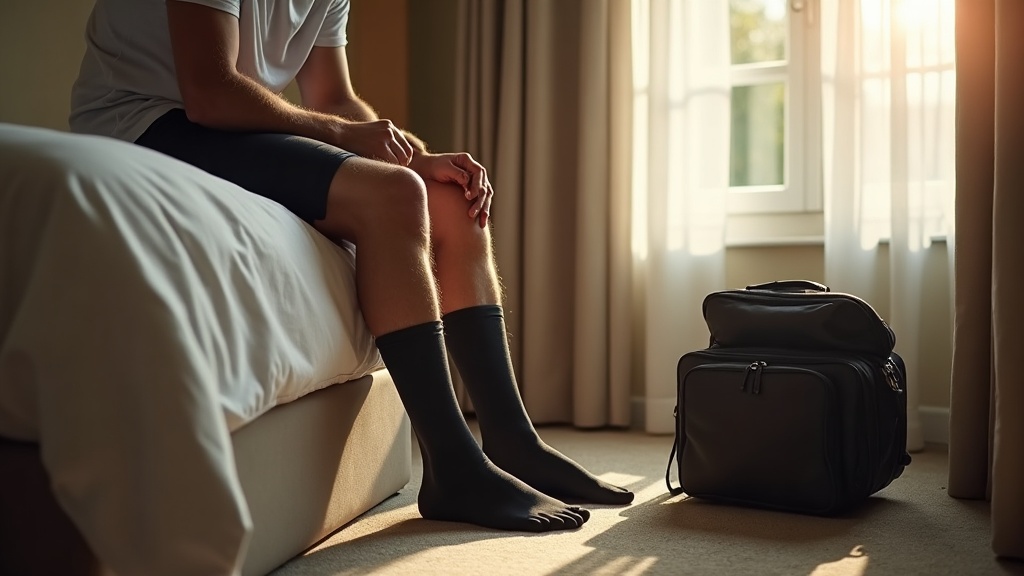
- High cotton content. Cotton absorbs sweat and loses its stretch. You want nylon-spandex or a merino blend.
- No mmHg rating on the packaging. If the brand doesn't tell you the compression level, it's not providing real compression.
- Uniform compression (non-graduated). Real compression socks are tighter at the ankle and ease up toward the knee. Anything uniform is just a tight sock.
- Sizing by shoe size only. Compression socks sized without calf measurement are built for a generic body that doesn't exist.
- Suspiciously cheap pricing. Under $8-10 a pair, you're usually getting a sock that loses its compression rating after three washes.
Bottom Line: What's Worth Your Hard-Earned Money
For most guys getting on a plane, the right call is a graduated 20-30 mmHg compression sock in a nylon-spandex blend, sized to your actual calf measurement. Put them on before you leave home. Keep them on until you're at the hotel and ready to get horizontal.
If you're a larger-framed man, shop specifically for wide-calf compression socks for flying and don't let the manufacturer talk you into a medium because of your shoe size. The savings aren't worth three days of aching legs at a jobsite in a city you don't know.
Spend $25-40 on a quality pair. They'll outlast the cheap versions by a dozen flights and actually do the job they're supposed to do.
