


If you searched for the best heavy duty leather work belt for tradesmen, you already know the problem. You've bought belts that looked the part, held up for six months, then cracked down the middle. Or belts that stayed stiff for their entire short life and left marks on your hip by noon. Or — maybe the worst — a belt that stretched out under a loaded rig and spent the rest of its days somewhere around your thighs.
Most guys assume leather is the automatic answer for heavy work. The truth is more interesting. And if you're willing to read past the first assumption, there's a better way to think about this.
Why Leather Has Always Been the Default for Work Belts?
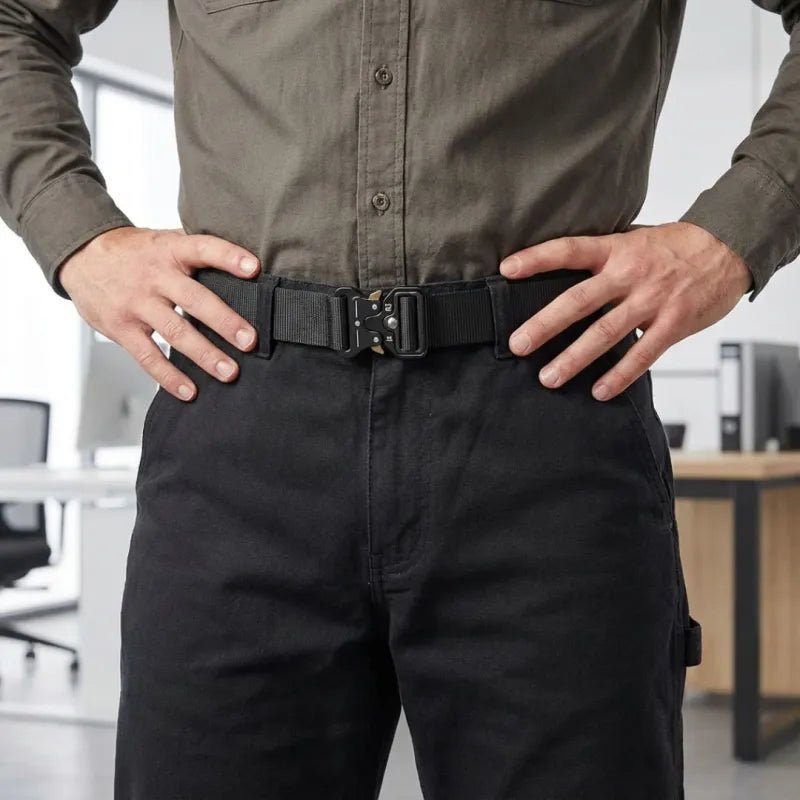
Let's give leather its due — because the reputation isn't unfounded. Full-grain leather is dense, abrasion-resistant, and stiff enough to carry loaded pouches without folding in on itself. When it's properly constructed — single-piece, solid metal buckle, 10 to 14 oz thickness — a leather work belt can outlast most of what gets marketed as its replacement.
Check out this guide: Cool Work Boots for Men – Stylish & Durable Picks
Tradespeople who've worn the same Carhartt or Occidental belt for a decade aren't wrong. They found something that works and stuck with it. For heavy carrying rigs — hammer loops, multiple pouches, tape measure holders, the full setup — a wide, thick leather belt handles load distribution in a way flimsy alternatives genuinely can't match.
So if you're building out a full tool belt system with pouches hanging off both sides, quality full-grain leather is still the right call. That's not up for debate.
But here's the thing most belt guides miss entirely.
The Problem With Leather Nobody Talks About Enough
For a lot of tradespeople, the best heavy duty leather work belt isn't actually a tool belt at all. It's a work belt. The one that keeps your work pants where they belong when you're climbing, kneeling, crouching on a slab, or pulling pipe through a ceiling. The one you wear all day under a tool rig, or on its own when the job doesn't need a full carry setup.
And for that use case — daily wear, movement, sweat, and shifting — leather has some real drawbacks. It doesn't breathe. A full leather waistband in summer is a miserable thing. It traps sweat, stiffens further, and starts to break down from moisture long before abrasion gets it.
It takes time to break in. A new leather belt is uncomfortable for weeks. That's acceptable if you're buying one belt for a decade. It's annoying if you're going through belts faster than that. It doesn't adjust easily mid-shift. If your waist changes throughout the day — which it does, because humans aren't static — a leather belt with fixed holes either fits or it doesn't.
And the most underrated issue: leather work belts for trousers often don't actually hold up as well as their reputation suggests, because the category gets lumped together. Budget leather — bonded, genuine, layered — cracks within months. You're not comparing bad fabric to good leather. You're often comparing bad leather to good leather, with the price difference invisible at the shelf.
What Actually Matters in a Heavy Duty Work Belt for Daily Wear?
Whether you're looking at leather or not, these are the things worth checking before you buy anything:
- Load capacity vs. use case. Are you hanging pouches off this belt, or is it just keeping your pants up while you work? The spec you need is different for each. Don't overbuild a pants belt and don't underbuild a tool rig belt.
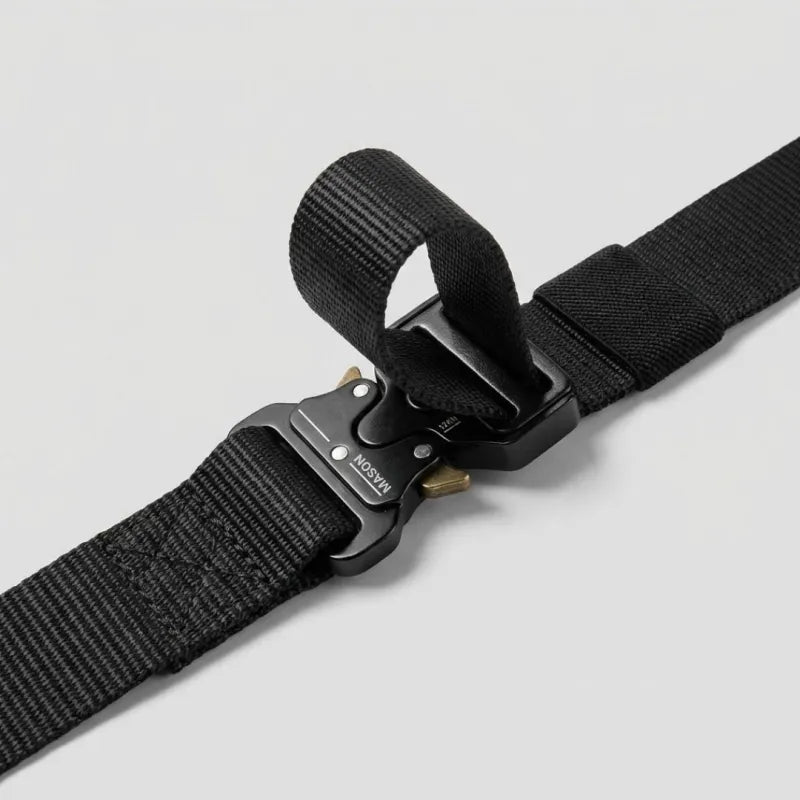
- Adjustability. A belt that adjusts continuously — not just at fixed holes — fits your body better across a full shift. Swelling, layering for cold, or just normal variation across a day: fixed-hole belts fight you on all of it.
- Buckle quality. This is where cheap belts die first. A thin stamped buckle bends under load. Solid steel or solid brass doesn't. If the buckle flexes when you pull it, put the belt back.
- Breathability. Underrated for daily wear. A belt that traps heat against your waist for ten hours adds fatigue you don't need.
- Width and loop compatibility. Most work pants are cut for 1.5" to 2" belts. Go wider than your loops and the belt rides up and twists. Check before you order.
Check out this guide also: Steel Toe vs Composite Toe Boots: Expert Guide to Choosing the Best Protection
The Case for High-Quality Fabric on a Daily Work Belt
Here's where it gets worth paying attention to.
The best heavy duty work belts for tradesmen in the daily-wear category are increasingly built from high-tensile fabric — not because it's cheaper, but because it solves the problems leather doesn't.
A well-constructed fabric work belt can match leather's tensile load for trouser use. It breathes. It adjusts across the full length without fixed holes. It doesn't stiffen in cold or degrade in sweat. And it moves with you — which matters when you're kneeling on a joist, twisting to get at a junction box, or going up and down a ladder forty times before lunch.
The key is quality of construction. A nylon belt with a plastic buckle is not the same thing as a reinforced fabric belt with proper metal hardware. The gap between those two things is as wide as the gap between bonded leather and full-grain.
That's exactly what Mason built into their work belt.
Mason Adjustable Fabric Work Belt — Built Around How Tradespeople Actually Move
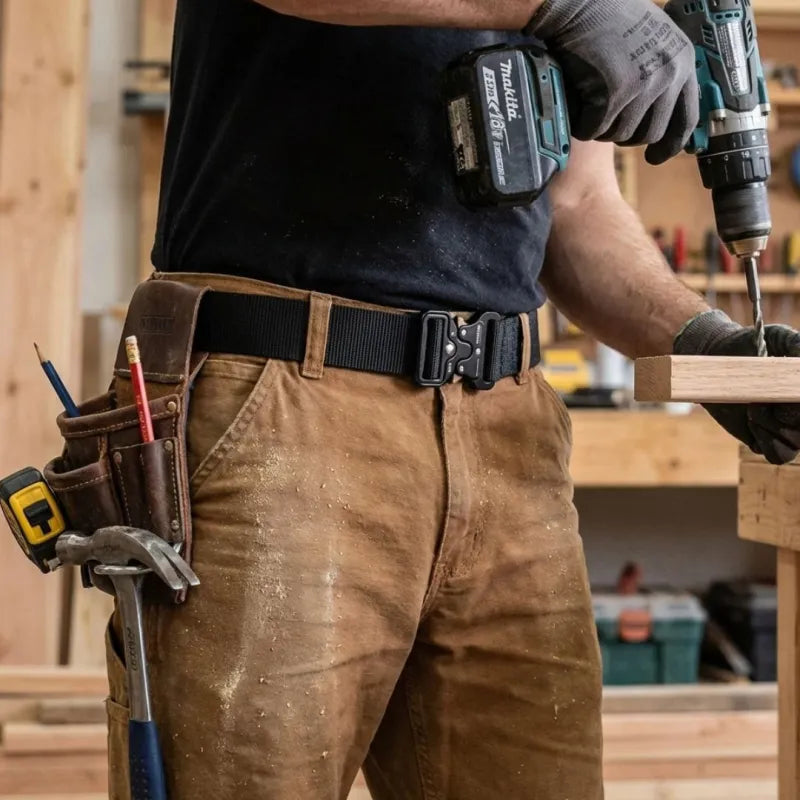
The Mason Adjustable Fabric Work Belt is designed with one job: secure your work pants without restricting movement across a full shift. It's not a tool belt. It's a precision work belt — the kind that disappears when you put it on, stays put through everything you do, and doesn't add friction to a day that already has plenty.
The adjustable system means you get a real fit, not an approximation. No wrestling with fixed holes when you're layering up in November or running hot in a crawl space. You set it once, it holds. The construction sits at Mason's standard for workwear — the same attention to materials and build that runs through their safety footwear and site pants. Solid hardware, reinforced fabric, designed for the kind of use that destroys cheaper versions inside a season.
For tradespeople who want a reliable work belt for daily use — and a separate rig for heavy tool carry — this is the practical choice. It does one thing, it does it well, and it holds up.
Check out this guide also: Work Boots for Back Pain: Expert Guide to Reducing Discomfort at Work
Leather or Fabric — The Honest Answer
There's no single best heavy duty leather work belt for tradesmen because tradespeople aren't doing one thing. If you're building a full tool-carry rig with multiple pouches and serious weight, leather wins on rigidity and load structure. Go full-grain, go thick, go solid hardware.
If you're looking for a daily work belt — the one you wear under everything, in all conditions, through twelve-hour shifts — a quality fabric belt built for tradespeople solves the problems leather doesn't. More adjustability, better breathability, better movement.
Most guys end up needing both. But the one that takes the most daily abuse and gets replaced most often? That's the work belt. And that's the one worth getting right. Mason built theirs to last. Worth looking at before you replace another one that didn't.
