



Most people pull those compression socks off the second they hit the jetway. That's the wrong move. Your circulation doesn't snap back to normal just because the wheels touched down.
Here's what you actually need to know: when to take them off, how long to keep them on, and whether you even needed them in the first place for that short hop you just took.
Key points at a glance
- Wait 1 to 2 hours after landing before removing compression socks, not right at the gate.
- For flights over 4 hours, keep them on until you've been walking around for a bit post-landing.
- Put them on before you board, ideally before your legs start dangling in a cramped seat.
- A 2-hour flight is low risk for most healthy adults; a 4-hour flight starts to matter more.
- Some people, including those with arterial issues, should skip flight socks entirely.
- Wearing compression socks too long (past 12 hours without a break) can cause skin irritation and pressure points.
Flight Compression Socks: What They Actually Do
The Short Answer: Wait 1 to 2 Hours After Landing Before Taking Them Off
Landing doesn't mean your legs are done with the problem. You've been sitting still for hours. Blood has been pooling in your lower legs the entire time, and that process doesn't reverse instantly when you stand up.
Keep the socks on for at least 1 to 2 hours after you land. Walk around the terminal, pick up your bag, get to your hotel or car. Once you've been moving for a solid stretch, then take them off.
If you've been on a very long flight, say 10 or more hours, err toward the 2-hour mark. The longer the flight, the more time your circulation needs to normalize on its own two feet.
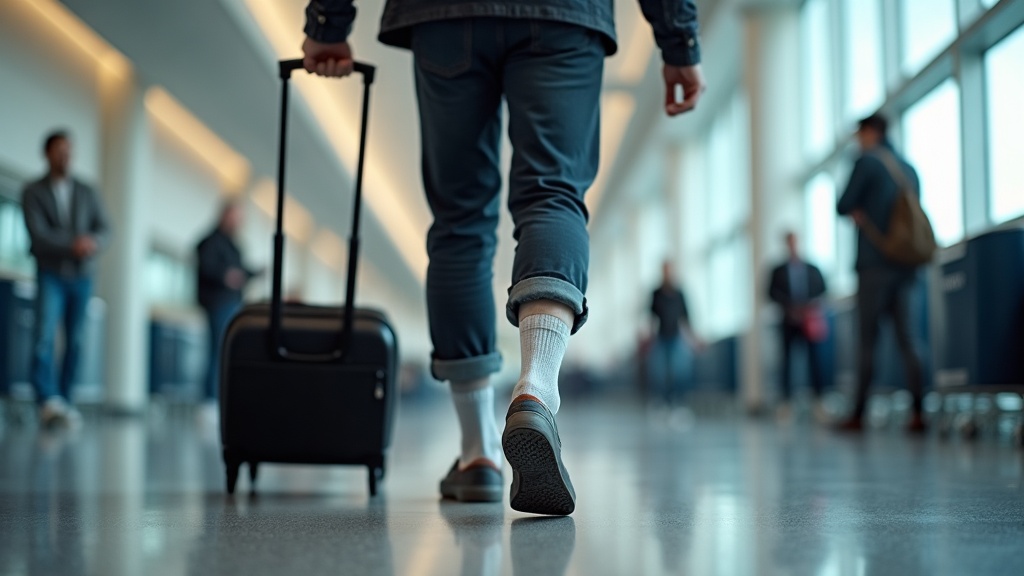
Why Your Legs Still Need Support After You Land
When you sit with your knees bent and your feet hanging for hours at cabin altitude, venous return slows down significantly. Your calf muscles, which normally pump blood back up toward your heart when you walk, have been doing almost nothing.
Removing the socks too soon lets that pooled blood stay right where it is. The compression is actively helping push it back up. Let it finish the job before you strip them off.
Did you know?
Deep vein thrombosis (DVT) risk doesn't evaporate at touchdown. Studies show the risk window extends up to 4 weeks after a long-haul flight, with the highest risk in the first few days. Staying mobile after landing is just as important as wearing the socks during the flight.
How Long Is Too Long to Wear Compression Socks on a Flight
There's a reasonable ceiling here. Most medical-grade guidelines suggest 8 to 12 hours as the practical upper limit for continuous wear, including both flight time and the post-landing window.
Going past 12 hours without a break can cause skin irritation, pressure sores (especially around the ankle bone), and numbness if the sock is bunched or misaligned. On a 14-hour flight, plan to take a restroom break and briefly readjust the socks mid-flight.
- Under 8 hours total wear: generally fine for healthy adults
- 8 to 12 hours: acceptable, check for bunching and pressure spots
- Over 12 hours continuous: take a break, remove briefly, inspect skin
- Sleeping in them on a long haul: okay if they fit correctly and aren't twisted
When to Put Them On Before Your Flight (You're Probably Doing This Wrong)
Most people stuff them in their carry-on and put them on at the gate, or worse, on the plane. By then your legs have already been sitting in check-in lines and airport chairs for an hour. The damage is underway.
Put them on at home, before you leave for the airport. That's the move. You want the compression working from the moment you start sitting, not an hour into your wait at the terminal.

Short Flight vs. Long Haul: Do You Actually Need Them for a 2 or 4 Hour Flight
For a 2-hour flight, the honest answer is: probably not, if you're a healthy adult with no risk factors. Two hours of sitting isn't enough time for serious venous pooling to develop in most people. Get up once, do some calf raises in the aisle, you're fine.
A 4-hour flight starts to change the math. That's long enough that swelling and fatigue become real. Compression socks for a 4-hour flight are worth it, especially if you have any of the risk factors below.
| Flight Duration | Recommendation | Notes |
|---|---|---|
| Under 2 hours | Optional for most | Low risk; skip unless you have known venous issues |
| 2 to 4 hours | Recommended with risk factors | Pregnancy, obesity, prior DVT, recent surgery |
| 4 to 8 hours | Recommended for most adults | Worth the minor hassle for meaningful swelling reduction |
| 8 hours and over | Strongly recommended | DVT risk increases significantly; wear from home to hotel |
What Not to Do While Wearing Compression Socks
Compression socks work because the pressure is graduated and evenly distributed. Mess that up and you create problems instead of solving them.
- Don't bunch them at the ankle. A fold or roll acts like a tourniquet. Smooth them out every couple of hours.
- Don't wear a size that's too tight. More compression isn't better. Stick to the measured mmHg range your legs actually need.
- Don't wear them over open wounds or broken skin without medical guidance.
- Don't sleep with them twisted or misaligned on a red-eye without checking the fit before you doze off.
Did you know?
The cabin pressure in a commercial aircraft is equivalent to being at roughly 6,000 to 8,000 feet of altitude. That lower pressure environment causes blood to flow more sluggishly and makes gas and fluid expansion more likely, which is part of why your ankles swell even on relatively short flights.
Who Should Skip Flight Socks Altogether
Compression isn't for everyone. There are real contraindications, and ignoring them can cause serious harm.
Talk to your doctor before wearing compression socks if you have any of the following:
- Peripheral artery disease (PAD) or other arterial circulation problems
- Severe peripheral neuropathy (you can't feel your lower legs well)
- Congestive heart failure that is poorly managed
- Skin infections, open wounds, or dermatitis on the lower leg
- Severe leg edema caused by congestive heart failure specifically
In these cases, the compression can restrict already compromised blood flow and make things significantly worse. When in doubt, ask your doctor before the trip, not after.

What Happens If You Skip Compression Socks on a Long Flight
For most people on most flights, nothing dramatic. You'll get off the plane with puffy ankles, tired legs, and that sluggish heavy feeling that hangs around for a day.
For people with higher risk, the stakes are different. DVT is a blood clot that forms in a deep vein, usually in the leg. It can break loose and travel to the lungs, which is a pulmonary embolism, a life-threatening emergency. The risk is real and it's disproportionately high in people who have had a prior clot, are pregnant, recently had surgery, or are significantly overweight.
Compression socks are cheap. A clot isn't. Do the math.
How to Pick a Pair That's Worth Your Money
You don't need to spend $60 on a pair of socks. But you also shouldn't grab the first thing that says "compression" in dollar-store packaging.
Compression level (mmHg)
- 15 to 20 mmHg: over-the-counter, good for most healthy travelers
- 20 to 30 mmHg: firm compression, better for people with known vein issues or previous DVT history (often prescription)
- Skip anything that doesn't list a mmHg rating at all
Material
- Nylon/spandex blends are the most common and hold their compression longer
- Merino wool options exist and breathe better, worth it for comfort on very long hauls
- Avoid pure cotton, it doesn't stretch consistently and loses compression faster
Fit
Measure your ankle circumference and calf circumference before buying. A sock that's too wide won't deliver the advertised compression. One that's too narrow will cut off circulation at the top band.
The Practical Checklist Before Your Next Flight
- Put socks on before you leave the house, not at the airport
- Stand up and walk the aisle at least once per hour on flights over 3 hours
- Do calf raises while seated: 10 reps every 30 minutes, it takes 20 seconds
- Stay hydrated, dehydration thickens blood and compounds clot risk
- After landing, walk for 1 to 2 hours before removing the socks
- Check for red marks, numbness, or skin irritation when you do take them off
- If your legs are still significantly swollen several hours after landing, that's worth a call to your doctor
