


Walk into any electronics section and half the watches claim to be rugged. Scratch-resistant. Military-grade. Built for the outdoors. Then you wear one on a real job site for two weeks and the screen fogs from the inside, the strap degrades in sunlight, or the GPS drops every time you're near heavy machinery.
"Rugged" on a spec sheet and rugged in practice are two different things. Manufacturers know the word sells — so it ends up on watches that don't really earn it. Before you spend money on a rugged smartwatch for outdoor work, here's what to actually check.
1. Water and Dust Resistance: What the Numbers Actually Mean
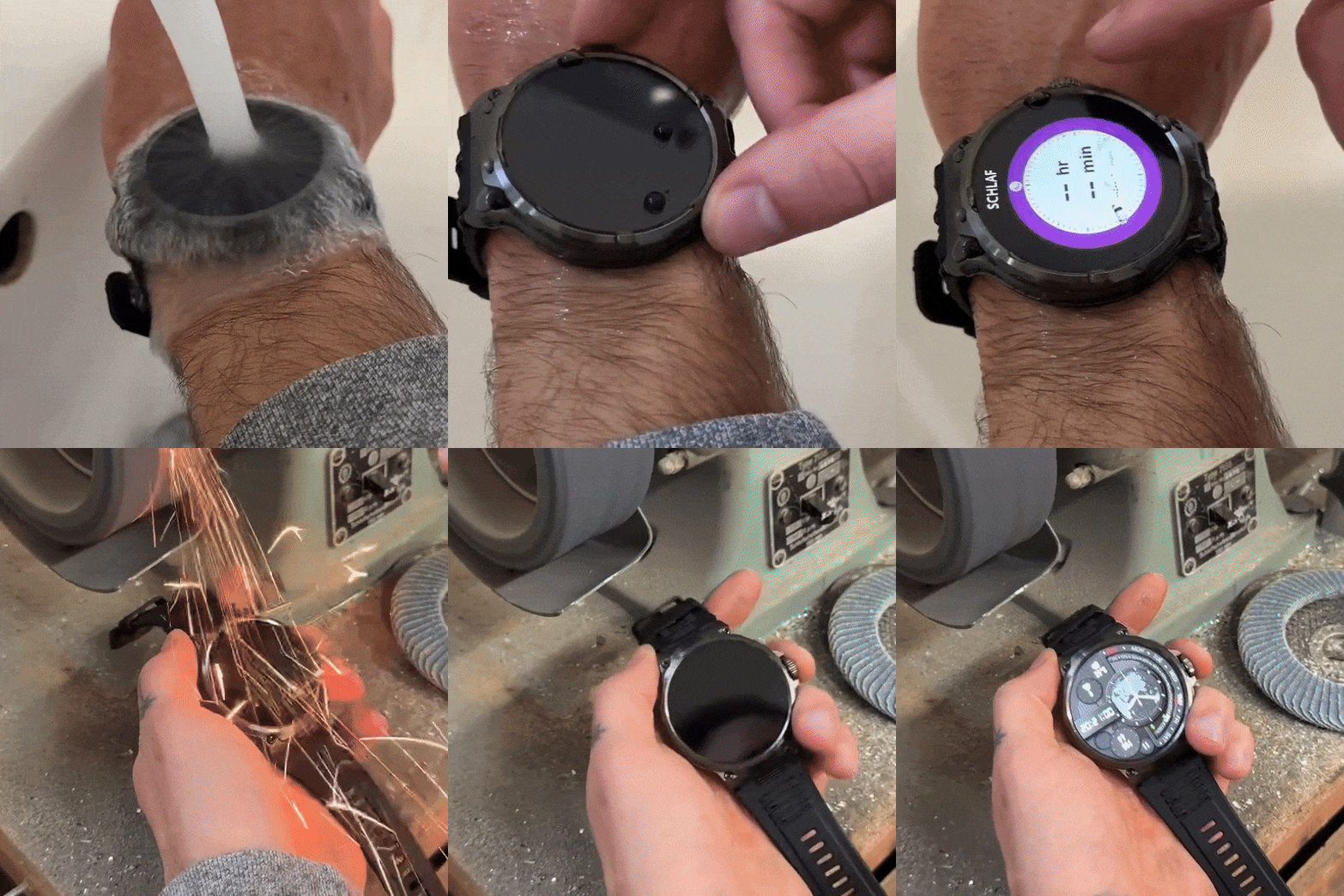
The IP rating is the first thing to look at. It tells you two things: dust protection (first digit) and water resistance (second digit).
For outdoor work, you want at least IP68 — that means full dust protection and water resistance down to 1.5 meters for 30 minutes. Some watches also carry a MIL-STD-810G or MIL-STD-810H certification, which means they've been tested against shock, extreme temperature swings, humidity, and altitude.
That second certification matters more than people realise. A watch can be IP68 rated but still crack when it takes a fall off a loading dock. Military standard testing covers impact — IP rating doesn't. One thing to check: whether the manufacturer tested their rugged smartwatch in conditions close to yours. Diving specs don't help much if you're working in dusty, dry heat.
2. Battery Life — Because a Dead Watch Is Useless
This is the one that people underestimate the most. Consumer smartwatches average one to two days of battery. On a long outdoor shift, that's not good enough — especially if you're using GPS tracking, which drains the battery fast. When you're choosing a rugged smartwatch for outdoor work, look for:
- GPS mode battery life, not just "smartwatch mode" (the two numbers can be very different)
- Whether the watch has a lower-power mode you can switch to mid-day
- How the battery holds up in cold weather (lithium batteries lose capacity below 0°C)
A watch advertised at "up to 14 days" might last four days with GPS on. Check reviews from people using it in field conditions, not just gym workouts.
Check out this guide too: Best Compression Socks for Work Tested by Experts
3. Screen Visibility Under Direct Sunlight
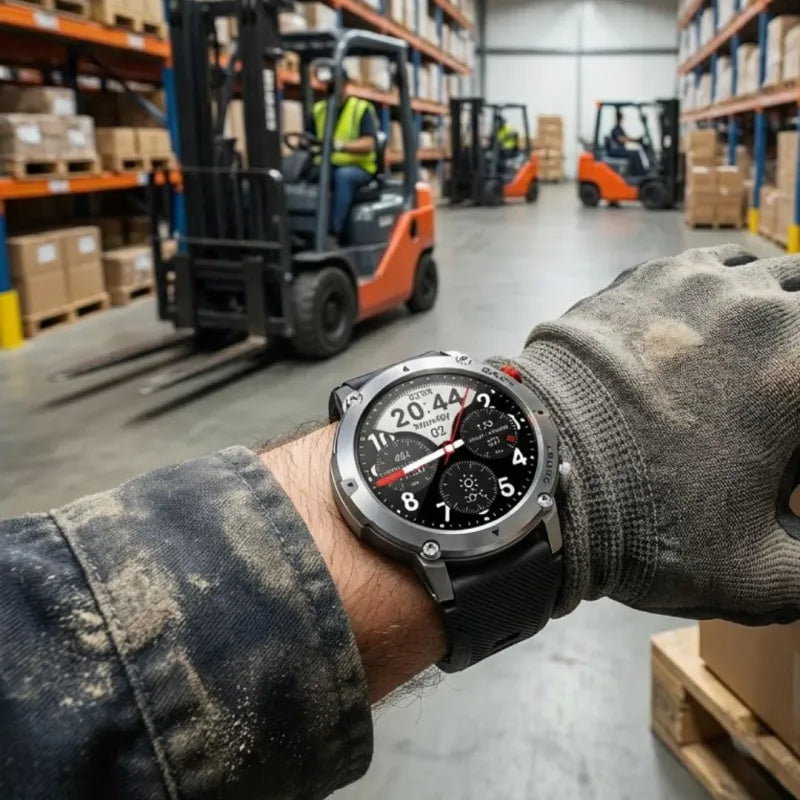
This one gets ignored until it becomes a daily annoyance. Standard OLED screens look great indoors and terrible in full sun. If you're working outside in the afternoon, you need either a high-brightness OLED (1000 nits or more) or an MIP (memory-in-pixel) display, which is readable in daylight without burning battery.
A scratch-resistant lens is worth checking too — Gorilla Glass or sapphire crystal are the two common options. Sapphire is harder to scratch but more likely to shatter on a hard direct impact. Gorilla Glass is more impact-resistant but scratches more easily. For outdoor work with rocky or abrasive surfaces, the choice isn't obvious.
4. GPS and Connectivity for Field Use
If you work across large outdoor areas, GPS accuracy starts to matter a lot. There's single-band GPS (standard, fine in open areas) and multi-band GPS, which holds signal better under tree cover, in valleys, or near tall structures.
Some rugged smartwatches also support satellite messaging networks like Garmin's inReach, which works in places with no mobile signal at all. That's a niche feature, but if you're in remote territory, it's worth knowing it exists.
For most outdoor work situations — construction sites, agriculture, forestry — standard GPS with solid accuracy is enough. What matters more is that the GPS chip locks on quickly and doesn't drop in areas with lots of metal or interference. A related point: check whether the watch pairs reliably with your phone's OS. Some outdoor smartwatches are optimised for one ecosystem and frustrating on the other.
5. Strap and Case Material
The strap is what fails first on most watches. Silicone straps degrade faster than most people expect in UV exposure. If you're working outdoors every day, a silicone strap can start cracking within six to twelve months. Rubber and fluoroelastomer straps hold up better. Metal straps are durable but uncomfortable in heat and can scratch surfaces you're working near.
The case material matters too. Reinforced polymer is lighter and doesn't conduct heat. Stainless steel is heavier but takes more punishment. Titanium gives you the best of both — light and tough — but it comes at a price. Also worth noting: lug width. If the strap breaks on the job, you want to be able to replace it easily with a standard size, not wait for a proprietary replacement.
Do you want to prevent falls and injuries at work? Find out: Best High Cut Safety Shoes: Expert Picks 2026
6. Health and Safety Features Worth Having
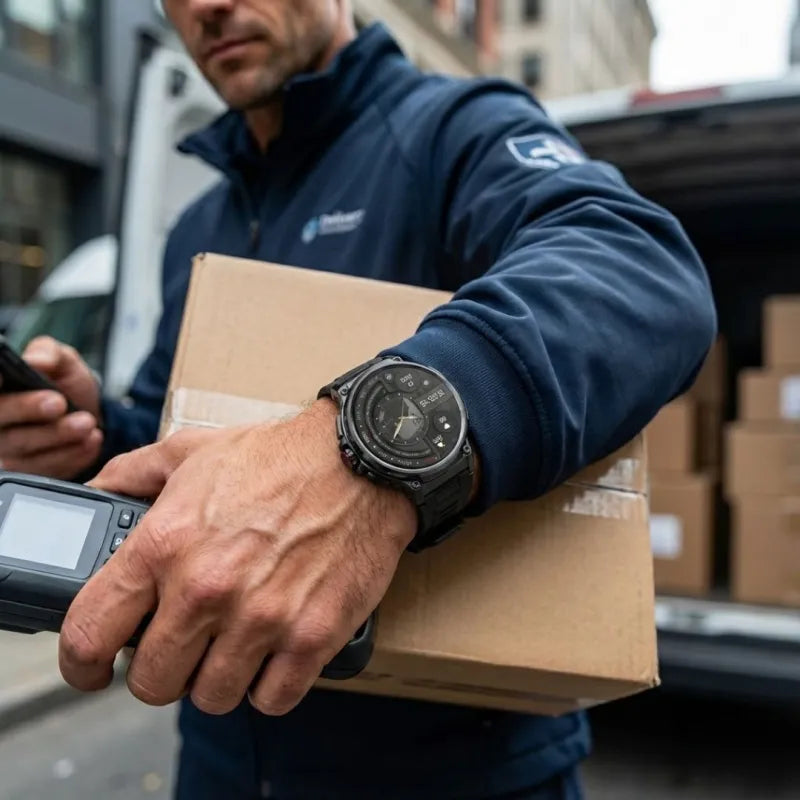
This is where outdoor work watches start to pull ahead of general fitness watches. Features that are genuinely useful in the field:
- Incident detection / fall detection — the watch detects a sudden hard impact and sends an alert if you don't respond
- Heart rate monitoring in high-heat conditions (useful for identifying overexertion)
- Pulse oximetry if you're working at altitude
- Altimeter and barometric pressure sensor — useful for weather changes in remote areas
You probably don't need ECG or stress tracking for outdoor work. Focus on the sensors that actually apply to your environment.
7. The Overlooked Thing: Interface Under Gloves
Most smartwatch reviews are written by people tapping a screen with bare fingers. On a real job site, you're often wearing gloves. Some watches have touch screens that work with gloves; most don't. Look for watches that have physical buttons for key functions — or check whether the manufacturer specifically mentions glove compatibility.
Voice controls can help here too, though they're not reliable in noisy environments. This is a small thing that becomes a big frustration if you get it wrong.
Do you work in construction? Check out: Construction Worker Accessories: 7 Must-Have Expert Picks
What to Actually Prioritise: Depends on Your Work
There's no single best rugged smartwatch for all outdoor work. It depends on what you're doing.
- Construction / heavy industry: prioritise drop resistance (MIL-STD certification), physical buttons, glove compatibility, and a simple interface you can operate quickly.
- Agriculture / forestry: GPS accuracy matters more here, along with long battery life and UV-resistant straps. Weather alerts from a barometric sensor are genuinely useful.
- Remote fieldwork / surveying: look at satellite connectivity options, multi-band GPS, and battery life in extended GPS mode. Incident detection is worth having if you work alone.
- General outdoor work: IP68, MIL-STD, good battery, readable screen in sun. You don't need every advanced feature — just the basics done properly.
Where to Find Rugged Smartwatches That Actually Deliver
If you're looking for a watch built for actual outdoor use — not just one that looks rugged — it's worth checking options that have been selected with field conditions in mind rather than gym performance. Mason's collection of rugged smartwatches covers the main bases: durable builds, field-relevant features, and specs that hold up in real conditions rather than just on a product page.
Browse Mason's rugged smartwatch collection.
Choose Your Rugged Smartwatch for Outdoor Work Now
Choosing a rugged smartwatch for outdoor work comes down to six things: IP and MIL-STD ratings, real-world battery life with GPS on, screen visibility in direct sun, GPS reliability in your specific environment, strap durability over months of outdoor use, and whether you can actually operate it with gloves on.
Most product pages won't tell you how the watch performs after six months in the field. Reviews from people using them in conditions close to yours are more useful than spec sheets. Get the basics right, and the watch disappears into your workday — which is exactly what it should do.
